
Our vision
Every Muslim should be able to check what they buy and use, whether it is food, medicine or personal care, without having to decode a label first.
AI-assisted halal check
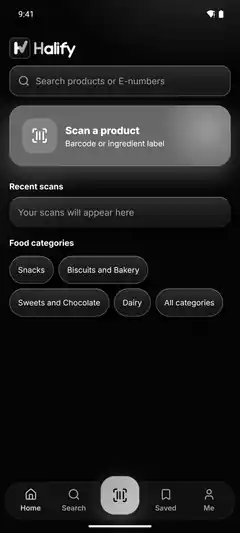
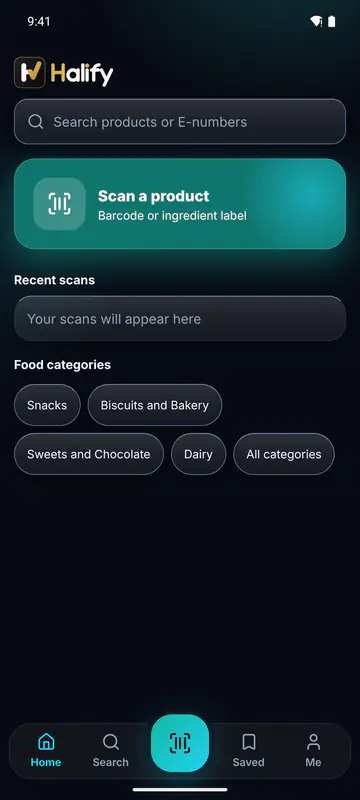
Halify is a free Android app that helps Muslim shoppers read what is in a product. It starts with food: scan a barcode, search by name or photograph the ingredient label, and see Halal, Mushbooh, Haram or Unknown, with the reason and the source. Medicine and cosmetics are planned to follow after launch.
Free. Android. Food first. AI-assisted, never AI-decided. Guidance only, not a fatwa.
Every Muslim should be able to check what they buy and use, whether it is food, medicine or personal care, without having to decode a label first.
Make the halal question easy to answer at the shelf. Use AI to do the hard reading of labels, and keep the decision with fixed rules and published sources. Show a clear verdict with the reason and the source for each ingredient. Say plainly what we do not know. Leave rulings to scholars. Start with food, then grow to medicine and cosmetics, one category at a time.
Halify is a small independent project. It is not only a food app. It is a halal-check companion for what Muslims buy and use. Food comes first. Medicine and cosmetics are planned after the first release.
We built it for a worry many of us know. You pick up a product and turn it over. The ingredient list is long and small. There is a code you do not recognise. A line says "enzymes" or "flavouring" and does not say where they come from. You cannot tell from the label alone whether it is halal. That is not your fault. Labels were not written to answer that question.
We wanted a quick way to check, with a reason you can read and a source you can look up. AI helps with the reading and the explaining. It does not make the decision. Then the choice is yours.
We are not a certification body. We do not issue rulings. We try to be clear, careful and honest.
We are a small team, so we move step by step. We read your feedback and your reports.
You scan or search. Halify does the reading and checking. You see the result and the reasons.
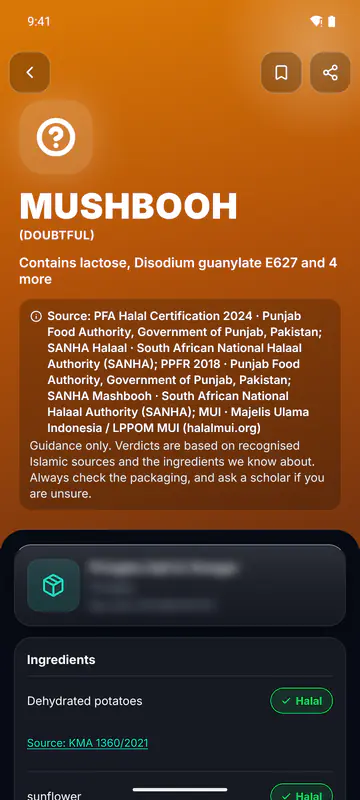
Point your camera at the barcode, or type a product name or brand. Halify finds the product and its ingredient list. No barcode match? Photograph the ingredient label instead. AI reads the text from the photo.
Halify reads the list item by item. (For a label photo, the text AI read goes through the same step.) It also spots E-numbers, even when written as "E471", "E 471", "INS 471" or "emulsifier (471)". Each item is matched against our reference list, which is built from published references. Only a full match counts. A partial word match does not.
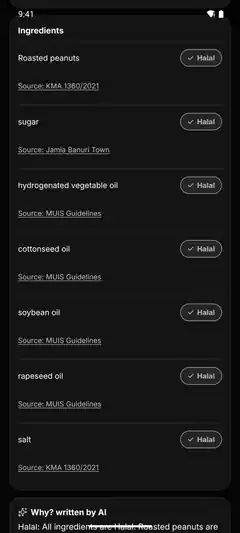
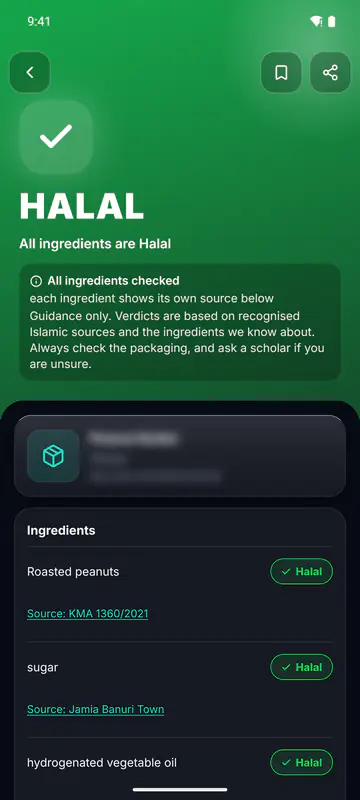
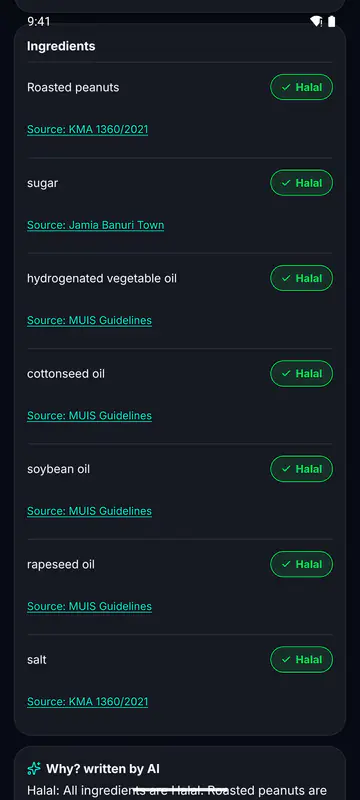
The screen names the ingredients that decided the verdict and the source for each. A "Why?" card gives a short, plain explanation written by AI from those same facts. It explains the verdict and never changes it. The rules in step 3 decide. Then you decide for yourself.
Not sure? Check the pack and ask a scholar.
Labels are hard to read, so Halify uses AI where it helps most. Then fixed rules and published sources make the decision.
Photograph an ingredient list and AI turns the picture into text.
That text goes through the same ingredient rules as any product. Nothing is skipped for a photo.
Every verdict can show a short, plain "Why?" note, written by AI from the facts the rules found.
AI can misread a blurry label or word a note badly, so every result shows its source and has a flag button, and you should always check the pack.
A verdict is guidance based on the ingredients and the references we use. It is not a ruling.
Every ingredient was recognised, and each one is listed as permissible in the references we use. The screen shows the reason and the source.
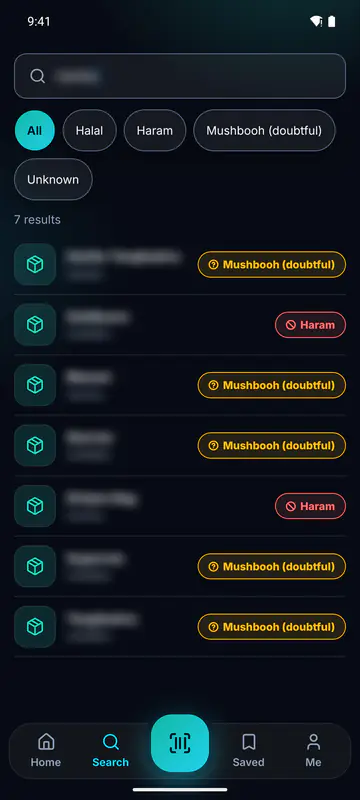
Doubtful. At least one ingredient is unclear, depends on how or from what it was made, or the references we use do not agree. We show you why and do not choose for you.
At least one ingredient is listed in our references as not permissible. The screen shows the reason and the source.
We could not recognise every ingredient, or there was no ingredient list. We do not guess.
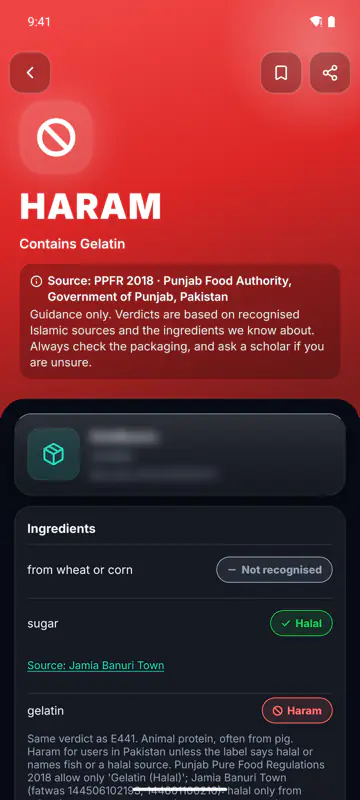
Colour is never the only signal. Each verdict also has a label and an icon. The strictest ingredient decides: one Haram ingredient makes the product Haram, and one Mushbooh ingredient makes it at least Mushbooh.
Halify does not invent verdicts. It matches each ingredient against a reference list we built from published references. Every ingredient shows its own source, so you can open it and read it yourself.
Every ingredient shows its own source. If an ingredient has no source in our list, it shows as not recognised, and the product cannot be Halal.
Who these are: governments, halal authorities and fatwa departments. We cite what they have published. We do not speak for them, and they do not endorse Halify.
16published references
The Punjab Pure Food Regulations 2018. A government regulation.
An official notification on the halal certification process.
A published notice about a food colour (E120).
Published answers from a Pakistani Islamic seminary's fatwa department.
Published scholarly answers on ingredients.
Published scholarly answers on ingredients.
Published scholarly answers on ingredients.
Published scholarly answers.
A decree listing materials exempt from halal certification.
Published articles and guidance from the Indonesian halal body.
A fatwa on yeast extract.
Its food additive listing.
Its religious guidelines for food and drink categories.
Its published E-number list.
Its published E-number list.
A published document on halal food and certification (2015).
Halify cites these published references. It is not affiliated with or endorsed by any of them. The list is growing.
We find the product, or you add it.
We read its ingredients and E-numbers, item by item.
We match each item, in full, against our reference list.
The strictest result wins: Haram, then Mushbooh, then Halal. Anything unrecognised stops a Halal result.
We show the verdict, the reasons and each ingredient's source.
Haram, then Mushbooh, then Halal. Anything unrecognised stops a Halal result.
The reference list is reviewed by the maker. Doubtful and not-permissible entries are checked by hand before they go in. Products you add are reviewed by a person before they appear. AI helps read label photos and writes short explanation notes. It never decides a verdict. The AI service used for this is Google Gemini (see the privacy policy).
Open the verdict screen and tap the flag button. A person reviews every flag. You can also write to halify.app@gmail.com.
Halify gives guidance only. It is not a fatwa and not a certification. Check the pack and ask a scholar if you are unsure.
Halify is not only a food app. It is meant to be a halal-check companion for what Muslims buy and use. We are growing it one category at a time.
Packaged food, drinks and snacks. This is what Halify checks at launch.
Checking medicines for ingredients that raise questions, such as alcohol or animal-derived parts.
Checking creams, soaps and similar products for animal-derived ingredients and other doubtful items.
Medicine and cosmetics are planned after the first release. We are not giving dates and we are not promising features. When a category is ready, it will appear in the app.
The catalogue is large, but a small team cannot add every product. If you find one we do not have, you can help.
If Halify cannot find a barcode, it will tell you.
Tap "Submit this product". Photograph the ingredient label, or type the ingredients.
We read every submission before it appears.
Nothing goes live automatically.
Every submission is reviewed by a person first. A product you add can help other shoppers.
No. Halify is meant to be a halal-check companion for what Muslims buy and use. Food is the first category at launch. Medicine and cosmetics are planned after the first release. There are no dates yet.
That is the plan, after launch. We would like to check medicines for things like alcohol and animal-derived ingredients, and personal care for animal-derived ingredients. We cannot say when. We will not announce a category until it is ready.
Labels are hard to read. A name can hide where an ingredient comes from. A code such as an E-number can stand for a plant, a mineral or an animal product. A line such as "enzymes" or "flavouring" often does not say. Most of us cannot know this by looking. Halify reads the list for you, checks each item against published references and shows the reason.
No. Halify gives guidance only. It helps you read the label and see what published references say. It does not issue rulings. For a decision you are unsure about, check the pack and ask a scholar.
No. AI helps read the label and writes a short explanation. The verdict is worked out by fixed ingredient rules from published sources. AI cannot change it.
Yes. AI can misread a blurry or curved label, or word a note badly. That is why every result shows its source and its ingredient list, and why there is a flag button. A person reviews flags. Always check the pack.
The privacy policy says: "When you check a product by photographing its ingredients label, the photo is sent from our server to Google Gemini, an AI service, to read the ingredients. We do not store the photo. We keep only the result (the ingredients read and the verdict), and only in your scan history if you are signed in." The photo is sent without a name or email address. If you add a photo when submitting a missing product, we keep it so a person can review it, and delete it 30 days after the review. Full details: https://halify.app/privacy.
No. It is not a fatwa and not a certification.
From our reference list of ingredients and E-numbers, built from published references such as the Punjab Food Authority's PPFR 2018, Jamia Banuri Town, MUIS, SANHA and others. See "Sources and how we decide". Every ingredient shows its own source. Halify is not affiliated with or endorsed by any of them.
Some ingredients are doubtful. They can depend on how they were made or where they came from, or the references disagree. We call these Mushbooh instead of forcing a Halal or Haram answer. The screen tells you why.
Yes, the app is free. It is supported by ads (Google AdMob banners) on a few screens. There are no ads on the scanner, verdict, E-number, saved or account screens. You can choose personalised or non-personalised ads.
If you sign in with Google, we hold your account details so your saved items and history can follow you. The full details are in our privacy policy: https://halify.app/privacy. The app is for people aged 13 and over.
In the app, open your account screen and choose delete. This removes your account and data. You can also read the steps at https://halify.app/delete-account.
Packaged food and drink for now, with about 10,000 products in the catalogue, including many sold in Pakistan. It is Android only for now, and in English. If your product is missing, send it with its ingredients from the app.
Yes. In the app you can send us a product we do not have, with its ingredients or a photo of its label. A person reviews every submission before it appears. Nothing goes live automatically.
Open the verdict screen and tap the flag button. A person reviews it. You can also write to halify.app@gmail.com.
Halify is a small independent project. See About above. You can reach us at halify.app@gmail.com.
Questions, a wrong verdict, a missing product or a privacy request? Write to us. We read every message.